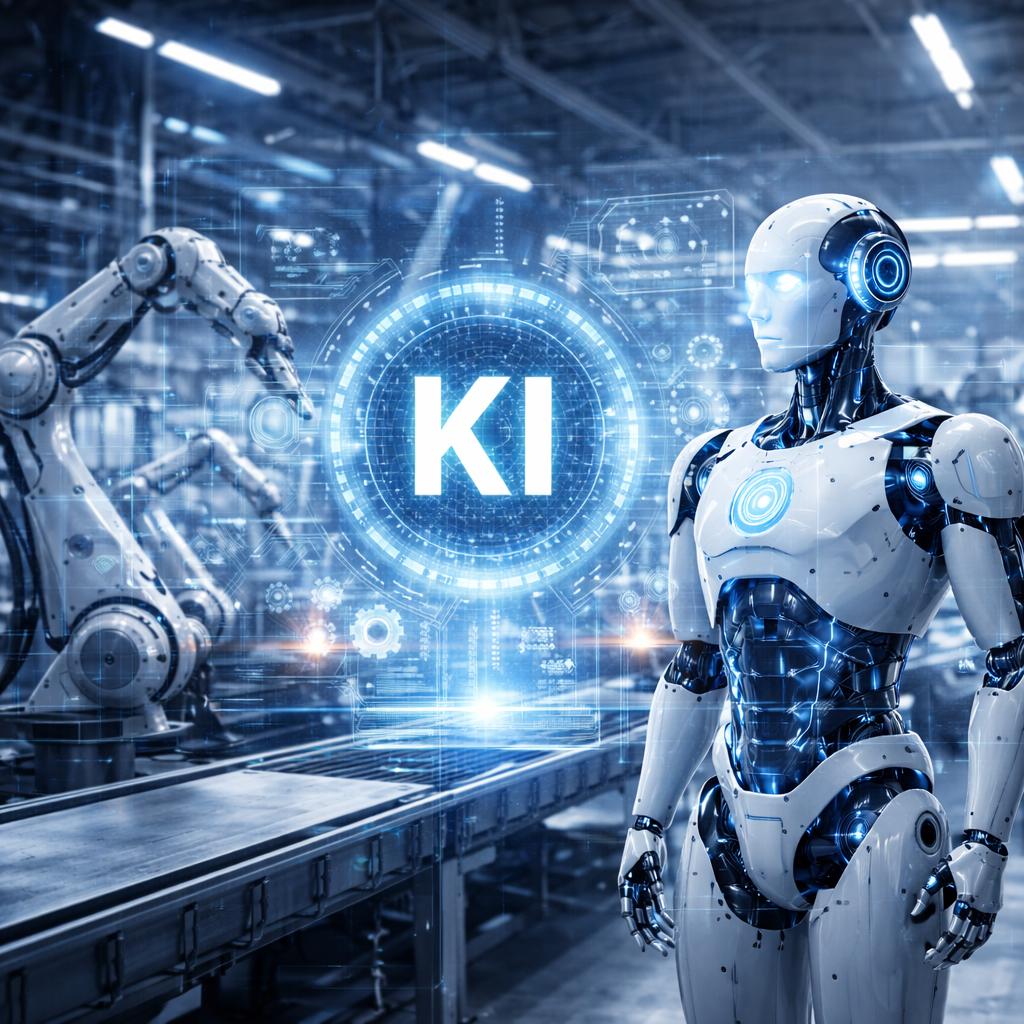
AI Consulting

AI Consulting:
From Idea to Effective Implementation

Artificial intelligence is no longer a future topic – it's a strategic success factor for industry and businesses. However, the added value doesn't come from tools or technology alone, but from the targeted integration of AI into processes, organization, and decision-making logic. This is precisely where our AI consulting comes in.

We help companies not only understand AI, but also use it effectively: practically, structurally, and with a clear focus on measurable results. Based on our modular approach – from strategic classification and technical and organizational readiness to concrete implementation on the shop floor, in processes, and in leadership – AI becomes a true "digital colleague" that reduces workload, accelerates processes, and enables better decisions

We always approach AI as a hybrid solution: humans and AI work together. Decision-making, responsibility, and leadership remain with humans – AI supports them through analysis, automation, and intelligent suggestions. Whether autonomous work systems, AI-supported shop floor management, process automation, or strategic decision support: our consulting combines industry experience with technological depth and a clear implementation logic. Our goal is clear: AI must be effective. Not sometime in the future, but now.


Your contact at IQX:

Reinhold Trummer

+43 676 677 30 85
This email address is protected from spambots. You need JavaScript enabled to view it.

Why decision-makers must act now – and how AI really works in industry

Artificial intelligence has arrived in industry – not as a futuristic vision, but as a real competitive factor. For CEOs, the question today is no longer whether to use AI, but how to integrate it into their own company in a targeted, secure, and effective manner. Because AI is not just another IT tool, but a business transformation instrument that is fundamentally changing processes, decision-making logic, and leadership.

Many companies start with individual AI applications or pilot projects. However, without clear objectives, governance, and integration into the organization, the impact remains limited. Real value creation only occurs when AI is systematically integrated into existing processes and operates as a capable system – from analysis and decision support to autonomous execution within clearly defined parameters. This is precisely where professional AI consulting comes in.

The benefits of AI are particularly evident in industry. On the shop floor, it accelerates control loops, makes decisions continuous rather than cycle-based, and increases transparency, stability, and productivity. Autonomous work systems, AI-supported shop floor management, and intelligent process control deliver measurable results—from cost reduction to relieving the burden on skilled workers. At the same time, responsibility remains clearly with humans: leadership shifts from operational response to prioritization, control, and strategic decision-making.

Successful AI integration follows a clear logic: strategic goal definition, realistic assessment of digital maturity, identification of effective use cases, and structured implementation. Humans and AI work together in a hybrid fashion – AI as a digital colleague that supports, analyzes, and accelerates processes, while decision-making authority, responsibility, and ethical guidelines remain with humans.

For decision-makers, this means: AI is leadership. Those who actively shape AI today create the foundation for competitiveness, resilience, and future security. Those who hesitate risk being overtaken by its rapid pace. The right moment to act is now.

Why choose AI consulting with IQX GROUP?

Because successful AI projects in industry don't begin with technology – but with business reality. The IQX GROUP combines industrial leadership experience with AI expertise and supports companies where AI truly makes an impact: in processes, on the shop floor, in decisions, and in the organization.

Our consultants are not just technology experts, but experienced industry professionals at the senior level. They are individuals who have held production responsibility, managed plants, implemented restructurings, and driven transformations. This understanding is crucial if AI is not to end up as an isolated IT project, but rather to make a measurable contribution to productivity, quality, costs, and resilience.

The IQX GROUP follows a clearly structured, modular approach: from strategic classification and maturity assessment to concrete use cases and implementation in operational practice. AI is not introduced as a black box, but as a specifically controlled system – with clear decision-making rules, governance structures, and a clear division of roles between humans and AI.

We place particular emphasis on core industrial areas: shop floor management, autonomous work systems, process automation, decision support, and leadership. AI is integrated where it accelerates control loops, creates transparency, and relieves the burden on managers – without relinquishing responsibility. The final decision remains with humans.

What sets IQX GROUP apart is its implementation strength. We always approach AI from a practical perspective: Which decisions will be improved? Which processes will be faster? Which organizations will become more robust? Instead of visions without impact, we deliver reliable roadmaps, realistic timelines, and measurable results.

For CEOs, this means: AI will not be introduced experimentally, but managed entrepreneurially. Structured. Secure. Effective.

The IQX GROUP stands for AI consulting with industry DNA – for decision-makers who don't want to talk about AI, but rather use it to achieve results.

IQX AIDA system

The IQX AIDA system (Artificial Intelligence Directed Action) is a holistic, modular approach for the successful implementation and scaling of artificial intelligence in industrial companies. The focus is not on the technology itself, but on its effective translation into business operations, operational excellence, and better decision-making.

AIDA combines strategy, organization, processes, and technology into an integrated overall approach. AI is not understood as an isolated IT project, but as a strategically controlled system of action that is embedded in existing structures and creates measurable added value. The modular structure enables a structured entry point aligned with the individual maturity level – from creating the necessary prerequisites to AI-supported decision-making and leadership.

The central principle of the IQX AIDA system is its consistent focus on implementation and impact. AI is used where it accelerates control loops, increases transparency, and relieves the burden on managers – while maintaining clear human responsibility and decision-making authority.

  • Module 1 – Creating the prerequisites for AI integration

    The sustainable use of artificial intelligence doesn't begin with algorithms, but with the reality of the company. Module 1 creates the necessary foundation for any successful AI initiative.

    The focus is on people, processes, data, IT architecture, applications, interfaces, and security. The goal is an honest assessment: How ready is the company for AI? Where are there gaps in data quality, infrastructure, or skills? Which organizational structures support—or hinder—the use of AI?

    This module prevents costly false starts. It ensures that AI is not built on unstable systems, but on a robust foundation. At the same time, strategic guidelines are defined: Where should AI provide support, where should humans make decisions, and what responsibilities remain clearly with management?

  • Module 2 – Autonomous work systems in production

    This module focuses on the application of AI where it generates directly measurable benefits: in day-to-day operations. Autonomous work systems – for example, in logistics, transportation, planning, or material flow – independently and reliably take over clearly defined tasks.
    The focus is on relieving the burden on employees, reducing manual tasks, and increasing operational stability. Crucially, it is not the technology alone that matters, but its integration into existing processes. Infrastructure, interfaces, security requirements, and employee involvement are all carefully considered. The result is real productivity gains, transparent profitability, and rapid wins – without any loss of control.

  • Module 3 – AI-integrated shop floor management

    Traditional shop floor management is highly human-centric and cyclical. Decisions are often delayed, based on meetings and manual evaluation. AI fundamentally changes this logic.
    In Module 3, shop floor management is enhanced by AI: control loops become data-driven, continuous, and significantly faster. Sensor events, deviations, and trends are automatically detected, evaluated, and—within defined limits—processed.
    Leadership remains central, but its focus shifts: away from operational reaction and toward prioritization, escalation, and control. This module ensures greater transparency, faster decisions, and a new level of operational leadership.

  • Module 4 – Hybrid Transformation and Process Map

    AI unfolds its greatest potential not in isolated applications, but in end-to-end processes. Module 4 systematically integrates AI into existing process landscapes.
    Humans and AI work together in a hybrid fashion. AI takes over clearly defined process steps, analyzes data, prepares decisions, or automates sub-processes. The existing IT architecture is enhanced with an intelligent automation and orchestration layer that makes processes flexible, scalable, and controllable.
    This module ensures that AI does not remain an alien element, but becomes an organic component of value creation.

  • Module 5 – AI-supported process flows

    Module 5 translates AI potential into concrete use cases. In functions such as purchasing, planning, quality, maintenance, engineering, HR, and sales, specific use cases are identified and implemented.
    These include predictive models, classifications, anomaly detection, image recognition, natural language processing, and generative AI. The focus is always on business impact: better decisions, lower costs, higher quality, and increased speed.
    This module ensures that AI doesn't remain abstract but becomes usable on a daily basis – embedded in real-world processes and responsibilities.

  • Module 6 – Human-AI Interaction: The Digital Colleague

    Acceptance determines the success or failure of AI. Module 6 consciously and systematically shapes the collaboration between employees and AI.
    AI is positioned as a "digital colleague": it supports, analyzes, suggests, and prepares – it does not replace. Employees retain decision-making authority and responsibility.
    This module addresses qualifications, role models, working methods, and trust. It ensures that AI is experienced as a relief, not a threat. At the same time, employees are empowered to use AI confidently and safely.

  • Module 7 – AI-supported decision-making

    Decisions are the central lever of entrepreneurial leadership. Module 7 uses AI specifically for preparing, evaluating, and simulating decisions – both operational and strategic.
    AI analyzes scenarios, recognizes patterns, assesses risks, and identifies possible courses of action. The final decision remains with a human, but becomes more informed, faster, and more transparent.
    This module improves the quality of decisions, reduces subjective biases, and creates traceability – a crucial advantage in complex, dynamic environments.

  • Module 8 – Virtual Leaders

    This module utilizes AI to actively support leadership tasks. Virtual leaders do not assume responsibility but support real-world leaders in coordination, prioritization, monitoring, and escalation.
    AI detects deviations, suggests corrective actions, monitors key performance indicators, and assists in managing complex organizations. Leaders gain time for what matters most: leading people, making decisions, and providing direction.
    This module specifically addresses growing organizations, increasing complexity, and limited management resources.

  • Module 9 – Ethics, Trust and Change

    This module accompanies all other modules throughout the process. It defines ethical guidelines, governance structures, and responsibilities for the use of AI.
    The goal is trust – both internally and externally. Legal requirements, transparency, fairness, and data security are considered, as are change management and communication.
    AI is not introduced as an end in itself, but as a responsibly managed system. The final decision-making authority always remains with humans. This module ensures that AI is accepted, understood, and supported in the long term.

Key skills for the transformation into the AI ​​era

  • 🧭 Strategic Thinking & AI Economics

    Artificial intelligence only realizes its full potential when consistently aligned with business objectives. Crucially, AI must be understood not as an isolated technology, but as a strategic tool for increasing productivity, quality, and competitiveness. Leaders must realistically assess the benefits, risks, and economic viability of AI initiatives and translate these into a clear overall strategy.

  • 📊 Data competence at all levels

    Data is the foundation of every successful AI application. Companies need a consistent understanding of data quality, availability, integration, and governance – across all functions. Only when data is structured, reliable, and used responsibly can AI systems deliver robust results and build trust.

  • ⚙️ Digital & technological competence

    A fundamental technological understanding is essential for the effective integration of AI. This includes knowledge of AI models, system and cloud architectures, interfaces, and IT security. The goal is not in-depth technological detail, but rather the ability to evaluate technology thoroughly and manage it effectively.

  • 🔄 Change capability & organizational mindset

    AI transformation is always also organizational and cultural development. New ways of working, changing role models, and accelerated decision-making processes require openness, a willingness to learn, and interdisciplinary collaboration. Acceptance arises where change is comprehensible, meaningful, and actively shaped.

  • 🧠 Leadership & decision-making skills in the AI ​​context

    AI supports decisions, but it doesn't replace them. Leaders must learn to correctly interpret data-driven analyses and recommendations and consciously incorporate them into their decisions. Clear decision-making rules, transparency, and accountability are essential prerequisites for trust in AI-supported leadership.

  • 🤝 Human-centered AI competence

    The success of AI depends significantly on its acceptance. AI systems must be understandable, user-friendly, and ethically responsible. Companies need the expertise to use AI in a way that relieves, supports, and empowers people – rather than unsettling or replacing them.

Read more… AI Consulting

  • Hits: 1059

Interim CSO

Interim CSO

Interim CSO – Temporary Sales Success

An interim Chief Sales Officer (CSO) takes over the strategic and operational leadership of sales when rapid, sustainable results are required. Whether it's increasing revenue, realigning the sales organization, or crisis management – ​​an experienced interim CSO brings fresh impetus, sets clear priorities, and ensures measurable success. No lengthy onboarding process, but with a clear focus: getting sales on track and securing growth.


Your contact:

Robert Pracher

+43 664 442 75 23
This email address is protected from spambots. You need JavaScript enabled to view it.

Are you looking for an interim CSO?

An interim CSO is always needed when sales faces major challenges and rapid, effective solutions are required. This can be the case when a company struggles with stagnant revenue or a lack of growth. Often, internal structures are no longer efficient enough to meet market demands. An experienced interim manager analyzes the root causes, defines clear measures, and implements them consistently – without the political constraints or delays that often occur in established organizations.

An interim CSO is also invaluable during periods of transformation. When markets change, customer demands evolve, or digital business models present new challenges for sales, someone is needed to drive the necessary realignment with foresight and assertiveness. This involves not only processes but also the people in sales. An interim CSO gets teams on track, clarifies the strategy, and ensures that changes are not only planned but also successfully implemented.

Besides strategic challenges, there are often operational reasons for employing an interim CSO. A vacant sales management position can quickly become a burden if customer relationships are not adequately maintained or teams operate without clear leadership. In such cases, an experienced interim manager provides stability, assumes responsibility, and ensures that the sales team remains effective – until a permanent solution is found.

Especially in internationalization projects or expansion into new markets, experience plays a crucial role. Anyone wanting to tap into new markets needs not only a strategy, but also a deep understanding of local conditions, sales structures, and customer expectations. An interim CSO brings this expertise, establishes sustainable processes, and ensures that the expansion not only works on paper, but also becomes a success in practice.

Interim CSOs are also frequently employed in M&A situations. When companies merge or are acquired, sales teams need to be integrated, strategies harmonized, and new structures created. Differing sales cultures can quickly lead to friction. An interim CSO ensures that the integration is seamless, synergies are leveraged, and the company quickly benefits from the new structure.

Whether it's a matter of rapid crisis intervention, implementing a new strategy, or bridging a vacancy – an interim CSO brings not only expertise but also the experience to implement changes consistently and effectively. The focus is not just on short-term solutions, but above all on a sustainable improvement in sales performance.

Main tasks of an interim CSO

  • Develop and implement a sales strategy

    The interim CSO analyzes the existing sales strategy, identifies weaknesses, and implements targeted optimization measures. This involves not only short-term revenue increases but also a strategic direction that enables sustainable growth. The interim CSO ensures that market potential is optimally utilized, the right target groups are addressed, and sales processes function efficiently.

  • Leading and strengthening sales teams

    A high-performing sales team needs clear leadership. The interim CSO takes charge of the team, instills motivation and structure, and ensures optimal performance. They identify skills gaps, conduct targeted training, and ensure that every sales representative utilizes their strengths to their fullest potential. Furthermore, they establish a performance-oriented culture that will lead to long-term team success.

  • Increase revenue and profitability

    Whether through targeted customer acquisition, cross-selling and upselling strategies, or improved pricing – the interim CSO always aims to improve the company's revenue and profitability. They work with data-driven methods, set clear KPIs, and ensure a sustainable increase in sales performance.

  • Optimize structures and processes

    Efficiency is crucial in sales. The interim CSO analyzes existing processes, identifies bottlenecks, and implements modern, digital, and scalable solutions. This includes CRM systems as well as reporting, lead management, and interfaces between sales, marketing, and service. The goal is to make the entire sales process leaner, more agile, and more customer-centric.

Required social skills of an interim CSO / sales manager

  • Communication skills

    An interim CSO must be able to communicate clearly – both internally and externally. Whether it's motivating the sales team, setting strategic directions with senior management, or convincing customers: successful communication is key to building trust and implementing change effectively.

  • empathy

    To successfully lead sales teams, you need to understand the people you work with. A good interim CSO recognizes what motivates employees, where resistance arises, and how to boost the individual motivation of each person. Only then can you win over a team and achieve ambitious goals together.

  • Assertiveness

    Change often meets with resistance. An interim CSO must be able to make unpopular decisions and implement them consistently – without provoking unnecessary conflict. They need the ability to assert themselves even in difficult situations and to set clear guidelines without appearing authoritarian or unapproachable.

  • adaptability

    Every company has its own culture, every market its own rules. An interim CSO must quickly adapt to new structures, manage diverse personalities, and respond flexibly to challenges. Those who stubbornly cling to a particular approach without considering the circumstances will not achieve lasting success.

  • Negotiation skills

    Whether it involves price negotiations with clients, coordination with internal stakeholders, or budget reallocation – an interim CSO must be able to convincingly represent their position while simultaneously finding compromises that are acceptable to all parties. Negotiation skills are a key competency for securing business success.

  • Decisiveness

    An interim CSO has no time for lengthy discussions. They must make quick but considered decisions, even when all the information is not available. This involves weighing risks, recognizing opportunities, and taking responsibility – without fear of making the wrong decision.

    These six social skills make the difference between an interim CSO who solves problems in the short term and one who puts sales on a long-term path to success.

Why an interim CSO for IQX?

We know that consulting often ends where real change begins. That's precisely why we do more than just offer sound advice – we take responsibility and implement it. From our many years of experience as management consultants, we understand the challenges companies face when it comes to not only developing strategies but also successfully putting them into practice.

This is where our unique approach comes in: We not only offer in-depth analyses and tailored concepts, but also support you as an interim CSO/Sales Manager throughout the implementation process. As part of your team, we work directly within your company, assume operational responsibility, and ensure that changes truly take effect.

Our advantage? We already know your business from in-depth analysis, understand the details, and have an unbiased view of the existing structures. This allows us to act faster and more effectively. While other interim managers are still trying to grasp the connections, we are already immersed in the action – with the knowledge of a consultant and the determination of a manager.

Our combination of consulting expertise and operational leadership ensures that we don't just talk, but act. We create clarity, provide guidance, and get things moving, while simultaneously laying the foundation for long-term success. The result is a company that is not only more stable but also emerges stronger from the change.

Read more…Interim CSO

  • Hits: 6125

News

News 2024

Dear readers,

Q3/2024 was an intense and exciting quarter – marked by new challenges and valuable successes. Together with our partners and customers, we made significant progress and gained important insights that pave the way for future developments. In this newsletter, we would like to give you an insight into the latest projects and strategies that have shaped our work and show how we continue to work on making our solutions even more targeted and effective. Let's look back together at the highlights of the past few months and find out what Q3 had in store for you.

Enjoy reading!

Read more…News

  • Hits: 7789

Interim Management Stuttgart / Baden-Württemberg

INTERIM MANAGEMENT BADEN-WÜRTTEMBERG

The Stuttgart/Baden-Württemberg industrial region is the vibrant heart of the German economy and a world-leading center for innovation and technology. Characterized by a long tradition in mechanical engineering, the automotive industry, and electrical engineering, this region combines traditional craftsmanship with state-of-the-art high-tech production. Companies here benefit from a unique blend of technological expertise, strong entrepreneurial spirit, and an excellent network of skilled professionals. Our interim management services support you in responding flexibly to the dynamic demands of this forward-looking economic region and in efficiently advancing your projects.


Your contact at IQX:

Klaus Besch

+49 172 740 22 30
This email address is protected from spambots. You need JavaScript enabled to view it.

The most important industries in the region

  • Automotive industry and mobility

    The automotive industry is the undisputed heart of the Stuttgart/Baden-Württemberg region and a global driver of innovation. With world-renowned corporations like Daimler and Porsche, the region has established itself as one of the most important locations for vehicle production. Here, not only are some of the world's most prestigious premium vehicles manufactured, but the future of mobility is also being shaped. The automotive industry in Baden-Württemberg extends far beyond traditional vehicle manufacturing. It encompasses a wide range of suppliers who develop innovative solutions in areas such as powertrain technology, electronics, and lightweight construction.

    The region has developed into a center for research and development in electromobility, autonomous driving, and connected vehicles. Close collaboration between industry, universities, and research institutes such as the Fraunhofer Institute ensures that Baden-Württemberg will continue to play a leading role in the global automotive industry. The region faces both the challenge and the opportunity to actively shape the transition to sustainable and digital mobility solutions and to reconcile its traditions with the demands of the future.

  • Mechanical engineering and industrial automation

    Mechanical engineering is deeply rooted in the history and culture of Baden-Württemberg and forms a central pillar of the regional economy. The region is known worldwide for its outstanding mechanical engineering expertise and its leading role in industrial automation. Companies such as Bosch, Festo, and Trumpf are global market leaders that set standards with high-precision machines, tools, and automation solutions. These companies not only shape the region's industrial landscape but are also significant drivers of innovation in international industry.

    Mechanical engineering in Baden-Württemberg is characterized by a high level of innovation, stemming from a close link between practical application and research. Companies collaborate closely with universities, universities of applied sciences, and research institutes to continuously develop new technological solutions. The region plays a key role, particularly in the era of Industry 4.0, where the digitalization of production is advancing rapidly. Companies in Baden-Württemberg develop intelligent production systems that network machines, equipment, and people, thereby significantly increasing efficiency and flexibility in manufacturing.

  • Electrical engineering and electronics

    Electrical engineering and electronics are further key industries in Baden-Württemberg, characterized by high innovation and technological excellence. Companies like Bosch, known worldwide as synonymous with technical precision and quality, are based in the region and shape the global market. The region is renowned for its advanced developments in sensor technology, microsystems engineering, and electronic components, which are indispensable in various industries, from automotive to medical technology.

    The electrical engineering industry in Baden-Württemberg benefits from a strong research landscape and excellent infrastructure. Numerous universities and research institutions work closely with industry to develop new technologies and bring them to market. The region plays a leading role, particularly in the development of electronics for vehicles and intelligent networks. Looking to the future, the electrical engineering industry in Baden-Württemberg is driving the development of key technologies that are crucial for digital transformation and the connected world.

  • IT and software development

    The Stuttgart/Baden-Württemberg region is one of the most economically significant and innovative regions in Europe. It is characterized by an exceptional industrial diversity, comprised of traditional strengths and future-oriented sectors. Here are the key industries that form the economic backbone of this region: 1. Automotive Industry and Mobility The automotive industry is the undisputed heart of the Stuttgart/Baden-Württemberg region and a global driver of innovation. With global corporations like Daimler and Porsche, the region has established itself as one of the most important locations for vehicle production. Here, not only are some of the world's most prestigious premium vehicles manufactured, but the future of mobility is also being shaped. The automotive industry in Baden-Württemberg extends far beyond traditional vehicle manufacturing. It encompasses a wide range of suppliers who develop innovative solutions in areas such as powertrain technology, electronics, and lightweight construction.

    The region has developed into a center for research and development in electromobility, autonomous driving, and connected vehicles. Close collaboration between industry, universities, and research institutes such as the Fraunhofer Institute ensures that Baden-Württemberg will continue to play a leading role in the global automotive industry. The region faces both the challenge and the opportunity of actively shaping the transition to sustainable and digital mobility solutions and reconciling tradition with the demands of the future. 2. Mechanical Engineering and Industrial Automation Mechanical engineering is deeply rooted in the history and culture of Baden-Württemberg and forms a central pillar of the regional economy. The region is known worldwide for its excellent mechanical engineering expertise and its leading role in industrial automation. Companies such as Bosch, Festo, and Trumpf are global market leaders that set standards with high-precision machines, tools, and automation solutions. These companies not only shape the region's industrial landscape but are also significant drivers of innovation in international industry. Mechanical engineering in Baden-Württemberg is characterized by a high level of innovation, which stems from a close link between practical application and research. Companies in Baden-Württemberg work closely with universities, universities of applied sciences, and research institutes to continuously develop new technological solutions. The region plays a key role, particularly in the era of Industry 4.0, where the digitalization of production is advancing rapidly. Companies in Baden-Württemberg develop intelligent production systems that network machines, equipment, and people, thereby significantly increasing efficiency and flexibility in manufacturing. 3. Electrical Engineering and Electronics: Electrical engineering and electronics are further key industries in Baden-Württemberg, characterized by high levels of innovation and technological excellence. Companies like Bosch, known worldwide as synonymous with technical precision and quality, are based in the region and shape the global market. The region is renowned for its advanced developments in sensor technology, microsystems technology, and electronic components, which are indispensable in various industries, from automotive to medical technology. The electrical engineering industry in Baden-Württemberg benefits from a strong research landscape and excellent infrastructure. Numerous universities and research institutions work closely with industry to develop new technologies and bring them to market. The region plays a leading role, particularly in the development of electronics for vehicles and intelligent networks. Looking to the future, the electrical engineering industry in Baden-Württemberg is driving the development of key technologies that are crucial for digital transformation and the connected world. 4. IT and Software Development The IT and software sector has become an essential component of Baden-Württemberg's economic structure in recent years. Stuttgart and the surrounding cities have become a magnet for IT companies and startups at the forefront of the digital revolution. The region benefits from its strong industrial base, which provides an ideal platform for the development and implementation of digital solutions. Companies in Baden-Württemberg develop software for a wide range of applications, from industrial automation and big data to artificial intelligence. The IT and software sector in Baden-Württemberg is highly networked and closely integrated with other industries. This enables the development of customized digital solutions specifically tailored to the needs of regional industry. Industry 4.0 is more than just a buzzword here; it is a reality being actively shaped by the region's companies. Furthermore, the region is a center for research and development in the field of IT security, which is crucial in an increasingly digital world. Baden-Württemberg plays a key role in digital transformation and will continue to be an important player in the global IT market.

  • Medical technology and biotechnology

    Medical technology and biotechnology have become significant growth sectors in Baden-Württemberg, internationally renowned for their innovative strength and quality. The region is home to leading companies such as Aesculap and Carl Zeiss Meditec, which are valued worldwide for their highly specialized medical devices and technologies. These companies benefit from their proximity to renowned universities and research institutions, which continuously generate new insights and support technology transfer to industry.

    The medical technology sector in Baden-Württemberg is characterized by its strong focus on precision and innovation. Companies in the region develop products that meet the highest quality standards and are used in diagnostics, therapy, and patient monitoring. Another key focus is the development of implants and surgical instruments used in hospitals and clinics worldwide. Baden-Württemberg has become one of the leading locations for medical technology in Europe, achieved through the close integration of research, development, and production. Biotechnology complements this sector by developing new therapeutic approaches and medical procedures that will shape the future of healthcare.

  • Environmental technology and renewable energies

    Baden-Württemberg is not only an industrial hotspot, but also a model region for sustainability and environmental technology. The region recognized early on that economic success and ecological responsibility must go hand in hand. Companies in Baden-Württemberg develop advanced technologies for utilizing renewable energies, increasing energy efficiency, and reducing environmental damage. Hydropower, which has long played an important role in the region due to its natural resources, is one example of the sustainable energy production practiced here.

    In addition to traditional hydropower, Baden-Württemberg relies on a wide range of renewable energies, including solar and wind power. The region is also a pioneer in the development of technologies for energy conservation and waste reduction. Companies and research institutions are working together on solutions that enable sustainable and environmentally friendly industrial production. The environmental technology sector in Baden-Württemberg benefits from strong political and societal commitment to climate protection, leading to continuous growth and increasing global significance. Baden-Württemberg demonstrates that economic prosperity and environmental responsibility are not opposites, but rather complementary.

  • Stuttgart and surrounding area

    Stuttgart, the capital of Baden-Württemberg, is the industrial heart of the region. The automotive industry is of particular importance here. Daimler AG (now Mercedes-Benz Group AG) has its headquarters in Stuttgart and has shaped the city's industrial landscape for decades. Porsche AG is also based here, making Stuttgart a globally significant center of the automotive industry.

    Besides the automotive industry, Stuttgart has a strong mechanical engineering and electrical engineering sector. Companies like Bosch, one of the world's largest automotive suppliers, are headquartered here. The presence of these companies has led to the development of a tightly networked system of suppliers, research institutes, and service providers, making the region a hub of innovation.

  • Karlsruhe region

    The Karlsruhe region is another important industrial location, characterized primarily by the electronics, IT, and energy sectors. Siemens has significant sites here and contributes to the region's innovative strength. The Karlsruhe Institute of Technology (KIT), one of Germany's leading technical universities, plays a central role in research and development, which is closely integrated with industry.

    The IT sector in Karlsruhe has gained enormous importance in recent years, earning the city the reputation of being an "IT hub." Companies like SAP, the largest European software company, are located in the region and contribute to its economic strength.

  • Ulm/Alb-Donau region

    The Ulm region and the surrounding Alb-Donau region are known for their strong pharmaceutical and chemical industries. Companies like Ratiopharm, now part of the Teva Group, originated here and contribute significantly to the region's economic development. Mechanical engineering is another important sector in the region, with companies like Wieland, a leading manufacturer of copper and copper alloys.

    Furthermore, the region is characterized by its medium-sized companies, which are often family-run and global leaders in niche markets. These companies form the backbone of the local economy and are a key pillar of economic stability.

  • Rhine-Neckar region

    The Rhine-Neckar metropolitan region, which includes cities like Mannheim and Heidelberg, is one of the most dynamic economic regions in Baden-Württemberg. Mannheim is a center of the chemical industry, with companies like BASF in nearby Ludwigshafen am Rhein. The mechanical engineering and automotive industries are also strongly represented, with companies like John Deere and Daimler operating production facilities here.

    Heidelberg is known for its university and research institutions, which collaborate closely with industry, particularly in the fields of biotechnology and medical technology. These synergies between research and industry make the region an innovation hub with a reach extending far beyond national borders.

  • Black Forest-Baar-Heuberg region

    The Black Forest-Baar-Heuberg region, located in southern Baden-Württemberg, is known for its highly specialized industry. Mechanical engineering, particularly precision engineering, dominates here. Companies such as Trumpf, a leading company in laser technology, and Hermle, a major manufacturer of milling machines, are based in this region.

    The watchmaking industry, which shaped the region for a long time, has since changed dramatically, but the tradition of precision and quality lives on in the companies that are now mainly active in metal processing and precision mechanics.

Why IQX for interim management?

We know that consulting often ends where real change begins. That's precisely why we do more than just offer sound advice – we take responsibility and implement it. From our many years of experience as management consultants, we understand the challenges companies face when it comes to not only developing strategies but also successfully putting them into practice.

This is where our unique approach comes in: We not only offer in-depth analyses and tailored concepts, but also support you as interim managers throughout the implementation process. As part of your team, we work directly within your company, assume operational responsibility, and ensure that changes truly take hold.

Our advantage? We already know your business from in-depth analysis, understand the details, and have an unbiased view of the existing structures. This allows us to act faster and more effectively. While other interim managers are still trying to grasp the connections, we are already immersed in the action – with the knowledge of a consultant and the determination of a manager.

Our combination of consulting expertise and operational leadership ensures that we don't just talk, but act. We create clarity, provide guidance, and get things moving, while simultaneously laying the foundation for long-term success. The result is a company that is not only more stable but also emerges stronger from the change.

Our services for the Stuttgart / Baden-Württemberg region:

  • Interim Managing Director / CEO
  • Interim CRO
  • Interim Plant Manager
  • Interim COO
  • Interim CFO
  • Interim Head of Human Resources
  • Interim Production Manager
  • Interim IT Manager (CIO)
  • Interim Head of Purchasing
  • Functions in the area of ​​operations
  • Interim Project Management
  • Implementation-oriented consulting
  • Employer Branding

  • Commercial Excellence

  • Digitization

  • Financial Leadership

  • Factory planning

  • Sustainability

  • Supply Chain Management

  • Mergers & Acquisitions

  • Operational Excellence

  • Product development

  • Restructuring

  • Task Force Management

  • Leadership

Read more ...Interim Management Stuttgart / Baden Württemberg

  • Hits: 8590